Global Ocean Freight Markets Diverge Sharply as Trans-Pacific Spot Rates Surge While Mediterranean Shipping Costs Plummet

The global container shipping market is currently witnessing an unprecedented and stark divergence between trans-Pacific and Asia-to-Europe trade lanes, upending traditional seasonal expectations and creating a complex operational environment for international logisticians, carriers, and cargo owners alike. While ocean freight rates from China to the North American West Coast have escalated dramatically over the past several months, mirroring the panic-buying dynamics of past disruptions, the cost of moving goods from Chinese manufacturing hubs to the Mediterranean has collapsed by more than half.
This widening chasm in pricing is forcing industry stakeholders to reevaluate long-held assumptions regarding the direct correlation between consumer demand and freight rate volatility. Traditionally, a widening pricing spread between major Western importing regions would signal an acute macroeconomic imbalance—namely, a desperate scramble for vessel space by American importers juxtaposed against a stagnant or contracting European consumer base. However, detailed maritime booking data and operational metrics reveal a far more intricate reality governed by supply-side bottlenecks, shifting vessel routing strategies, and the structural concentration of global shipping capacity.
The Tale of Two Trade Lanes: Tracking the Divergence
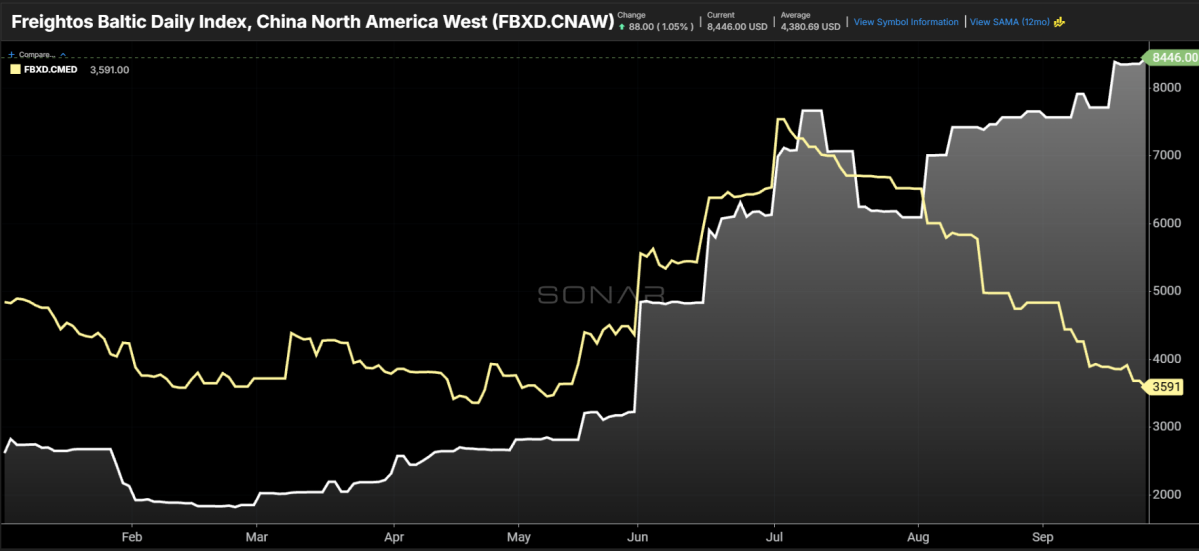
The shifting financial landscape of maritime logistics is most vividly illustrated by benchmark spot indices provided by the Freightos Baltic Daily Index (FBXD). Throughout June and the early weeks of July, container shipping rates from China to the North American West Coast (FBXD.CNAW) and to the Mediterranean (FBXD.CMED) moved in tandem, reflecting broad seasonal pressures. However, over the subsequent seven weeks, these two major arteries of global trade decoupled entirely, charting opposite courses that have fundamentally rewritten the cost structure of international commerce.
By late September, the FBXD.CNAW index closed at $8,446 per forty-foot equivalent unit (FEU). This figure represents an extraordinary valuation: nearly double the 12-month trailing average of $4,381 per FEU and roughly fourfold the rates paid by shippers for the exact same routing in September 2025.
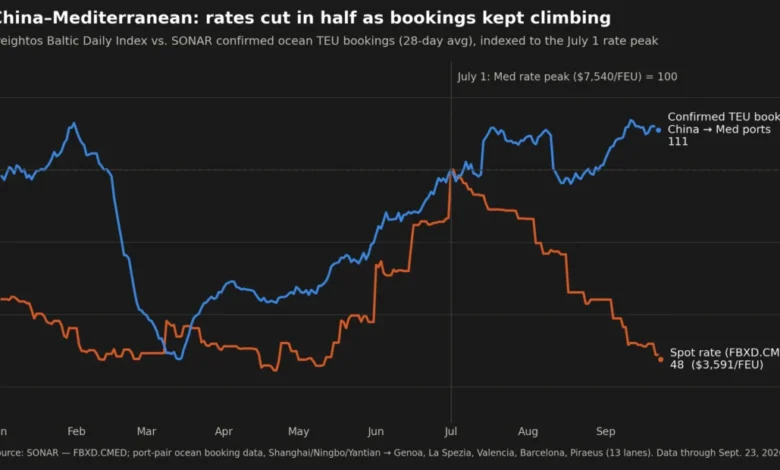
Conversely, the China-to-Mediterranean index (FBXD.CMED) experienced a severe contraction. Plummeting from a summer peak of $7,540 per FEU in July, the index dropped to $3,591 per FEU—a reduction of more than 50% that pushed pricing below the levels recorded at the onset of the year.
To contextualize the dramatic shift: in January, transporting a standard forty-foot container from China to Mediterranean gateways such as Genoa or Valencia carried a cost roughly 1.7 times higher than moving that same box to Los Angeles or Long Beach. By late September, that economic relationship flipped on its head. A West Coast delivery now commands a staggering 2.35-multiplier premium over a Mediterranean-bound container, creating immense margin pressures for importers reliant on trans-Pacific supply chains.
Interrogating the Demand Narrative
Standard economic theory would dictate that a pricing divergence of this magnitude is fueled by surging import demand in North America coupled with a severe contraction in European consumption. Yet, port-pair ocean booking data compiled through modern freight visibility platforms tells a distinctly different story.
Confirmed twenty-foot equivalent unit (TEU) bookings originating from major Chinese export hubs—including Shanghai, Ningbo, and Yantian—destined for five primary Mediterranean ports demonstrate robust resilience, registering a 38% increase compared to the same period in the previous year. Furthermore, across a broader examination, 11 out of 13 specific Mediterranean trade lanes exhibit year-over-year volume growth. On a 28-day moving average, bookings into the region have climbed approximately 11% since the market rate peak in July.
A parallel trend is visible in Northern Europe. Confirmed bookings from the same Chinese origins into North European ports are up 26% year-over-year and have grown by 7.5% since July. These figures confirm that European consumer and industrial demand is neither collapsing nor stagnating; rather, import volumes are holding steady or expanding even as carriers slash spot rates by half.
In contrast, the trans-Pacific booking data presents a more fragmented and uneven picture. Total confirmed TEUs moving from China to the combined U.S. and Canadian West Coast are up roughly 50% year-over-year, but this aggregate figure masks underlying concentration. The vast majority of this volume expansion is anchored in the Port of Long Beach, where confirmed bookings across all three primary origin lanes have more than doubled.
When evaluating the broader trans-Pacific market, the median West Coast lane reveals a modest year-over-year growth rate of just 1%. Import bookings into the Port of Los Angeles originating from Ningbo have declined by 33%, while major gateways such as Oakland and Seattle report downward trends across the majority of their inbound lanes. Even under the most generous analytical interpretation, cargo volumes entering the North American West Coast are rising at a mere fraction of the pace set by spot market rates. While booking figures do not account for late-stage cancellations or rolled cargo, the sheer scale and geographic breadth of the data indicate that standard demand fluctuations cannot account for the massive disconnect in pricing.
Supply-Side Mechanics and Route Optimization
If demand fundamentals fail to explain the widening gap between the trans-Pacific and Mediterranean pricing environments, the answer must be sought on the supply side of the equation. Operational adjustments by major ocean carriers have created vastly different capacity realities in each respective hemisphere.
On the Asia-Europe trade route, major ocean carriers have progressively pivoted their networks back toward traditional routings through the Suez Canal. Prominent global lines, including Maersk and Hapag-Lloyd, shifted additional Asia-Europe services away from the longer Cape of Good Hope detour, contributing to a 54% year-to-date increase in Suez container tonnage. This strategic normalization significantly shortens transit times, freeing up vessels that were previously absorbed by extended Cape voyages. As a result, effective capacity on the Asia-Europe and Mediterranean lanes has grown at a pace that comfortably outstrips cargo volume growth. Concurrently, carrier service metrics indicate a softening stance on space allocation; carriers are rejecting a smaller percentage of Mediterranean bookings compared to the previous year—down to 7.1% from 8.3%—signaling ample available capacity in the market.
The trans-Pacific operating environment, however, has faced a severe capacity contraction. A succession of typhoon disruptions at key Chinese export hubs beginning in mid-July pulled vital vessels out of standard rotation schedules, causing cascading delays and schedule reliability crises. Ocean carriers responded aggressively to these disruptions by deploying blank sailings—with some individual weeks seeing as many as nine cancelled sailings announced simultaneously.
Compounding these supply constraints are rising operational expenditures. Geopolitical tensions surrounding the Strait of Hormuz have pushed bunker fuel costs upward, establishing a high cost floor for trans-Pacific loops and longer global routings. According to global schedule reliability data published by Xeneta, only 29% of container vessels arrived on time globally in August, marking the third consecutive monthly decline in schedule integrity.
Market Concentration and Price Rationing
While supply constraints and port disruptions provide vital context, they still do not fully account for the extraordinary magnitude of the trans-Pacific rate spikes. Interestingly, data analytics show that carriers are actually rejecting a smaller percentage of West Coast bookings than they did a year ago—8.3% compared to 10.1%—despite spot rates quadrupling over the same timeframe.
This paradoxical dynamic suggests that vessel space on the trans-Pacific lane is being rationed primarily through pricing mechanisms rather than an absolute physical shortage of ships. Spot rates apply strictly to the fraction of cargo not locked into long-term annual service contracts. In an industry where roughly 90% of global container capacity is consolidated among just ten major carrier alliances, even minor tactical adjustments in available spot capacity can trigger outsized, volatile price swings in both directions. When carriers withhold small increments of capacity through blank sailings or slow steaming, the residual spot market experiences extreme pricing pressures.
Implications and the Outlook Ahead
As the global container shipping market navigates the final quarter of the year, industry observers are closely monitoring upcoming operational milestones. The immediate test for trans-Pacific pricing arrives in early October, coinciding with the traditional surge of export activity ahead of China’s Golden Week factory shutdowns. Industry analysts anticipate one final upward push on trans-Pacific spot rates as manufacturers race to dispatch goods before holiday closures take effect.
Following the Golden Week holiday, however, market fundamentals suggest a potential softening of rates. As seasonal congestion clears and carriers reintroduce capacity that had been artificially restricted or delayed by Pacific typhoons, pricing pressures could abate rapidly. If the Mediterranean trade lane serves as any historical or empirical guide, it demonstrates that trans-Pacific spot rates possess the capacity to correct downward at a remarkable velocity, even in an environment where underlying cargo bookings remain relatively stable.
For beneficial cargo owners (BCOs) and freight forwarders, the current market climate underscores the critical necessity of agile procurement strategies, robust multi-lane diversification, and real-time visibility tools. As the structural divergence between the East-West and Europe-bound corridors persists, supply chain leadership must navigate a landscape where operational efficiency and pricing volatility are inextricably linked.